

The Authenticity of Scripture: Irrefutable Evidence of God’s Word
The question of whether the Bible is merely a collection of ancient myths or a divinely inspired record of truth is one of the most significant inquiries of human history. The evidence supporting the authenticity of Scripture is not only substantive—it is overwhelming.
From textual verification and archaeological findings to precise prophetic fulfillment, the Bible stands as a unique, demonstrably true document that defies the limitations of human composition.
The Bible was not created by councils or politicians—it emerged as God inspired authors and the Church recognized what was already authoritative. The Old Testament’s accuracy is verified by the Dead Sea Scrolls (250–100 BC), which match today’s Hebrew Bible nearly word-for-word.
The Septuagint (Greek translation, 250–150 BC) proves the Old Testament was complete and in use before Christ. Jewish scribes later preserved the text through the Masoretic tradition (AD 100–300).
The New Testament was written between AD 45–95 by apostles and their direct companions. Early leaders like Clement, Ignatius, and Polycarp (AD 95–150) quoted the same texts we have now.
The Muratorian Fragment (AD 170–200) lists nearly all New Testament books; Athanasius’ Easter Letter (AD 367) included the same 27 books we use today.
The Councils of Hippo (AD 393) and Carthage (AD 397) affirmed what believers already recognized as inspired. Later, the Council of Trent (AD 1546) officially restated this canon in response to the Reformation—it did not create Scripture.
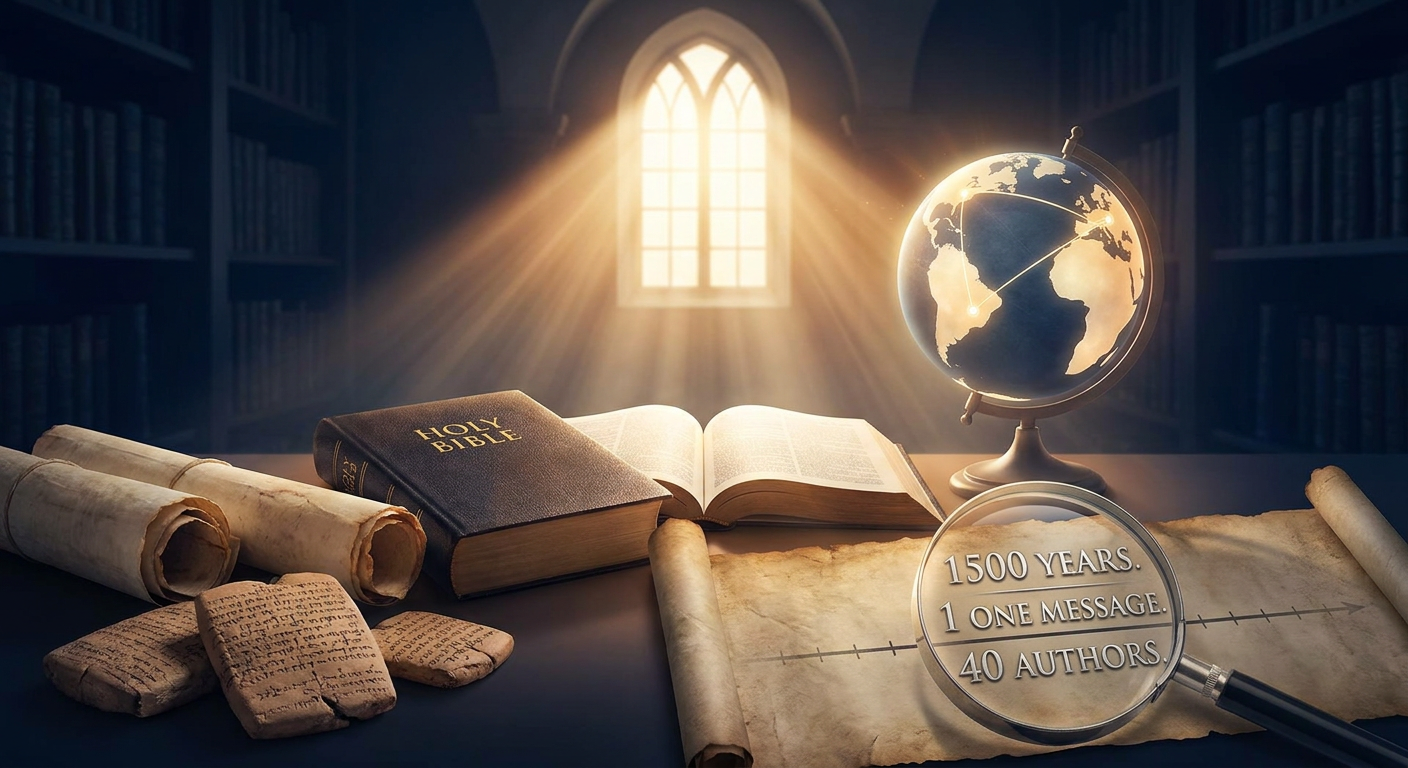
Across 1,500 years, written by 40 authors on 3 continents, the Bible maintains one message: God’s redemption through Jesus Christ. We don’t worship the Bible—it is the divinely inspired and historically reliable Word of God.
Standards for Historical Reliability
1. Manuscript Evidence – Number and consistency of surviving copies.
2. Time Gap – Years between the original writing and earliest copy.
3. External Corroboration – Confirmation by archaeology or non-biblical sources
Manuscript Evidence
Critics often challenge the reliability of ancient texts, but when held to the rigorous standard of textual criticism, the Bible proves to be the most authentic document from antiquity.
Compared to other classical works, the New Testament possesses an unparalleled volume of supporting manuscripts, a significantly shorter time gap between the original writing and the earliest known copy, and a higher degree of textual accuracy.
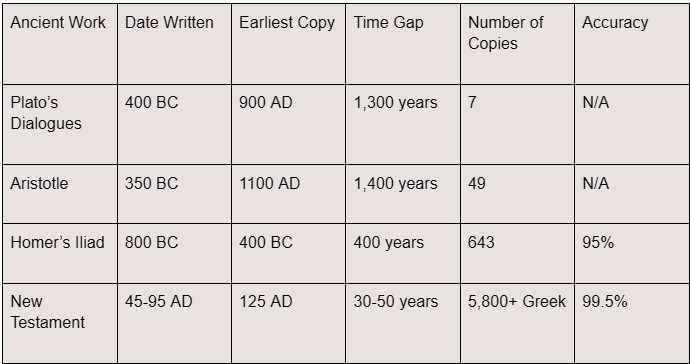
Scholars routinely deem Plato’s Dialogue’s as historically reliable despite having only 7 known copies and a massive temporal gap. The New Testament—with over 5,800 Greek manuscripts and nearly 24,000 total copies—stands as the most attested book in history.
Over 300 Fulfilled Prophecies
The Bible distinguishes itself through predictive prophecy, asserting that future events are known by God alone. The mathematical impossibility of fulfilling these prophecies by chance defies naturalistic explanation.
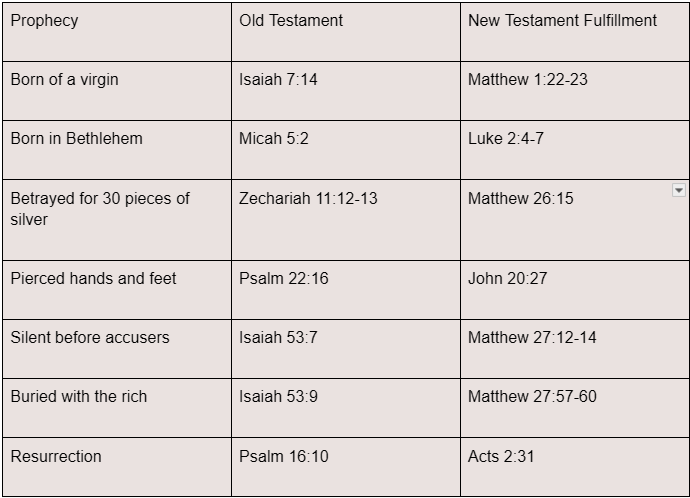
To visualize this: if you covered the state of Texas in silver dollars two feet deep and marked one of them, the chance of a blindfolded person picking that specific coin on the first try would be equivalent to the probability of these prophecies being fulfilled by coincidence.
1 in 10^17!!
Archaeological Confirmation
Over 25,000 archaeological discoveries confirm names, places, and events in Scripture.
• Non-Christian historians like Josephus and Tacitus reference Jesus and early Christianity.
• Luke’s Gospel and Acts contain over 80 verified historical details confirmed by archaeology (Sir William Ramsey) ”The Bearing of Recent Discovery on the Trustworthiness of the New Testament”).
Formation & Preservation
The preservation of the Bible is a testament to its unique character.
Canon: The Muratorian Fragment (170–200 AD) lists almost every New Testament book. In 367 AD, Athanasius’s Easter Letter identified the same 27 books used today. Church councils in Hippo (393 AD) and Carthage (397 AD) merely recognized what the early church had already accepted as authoritative Scripture for centuries.
The New Testament: Written between 45–95 AD by apostles, the text was confirmed by early church leaders like Clement, Ignatius, and Polycarp (95–150 AD) through constant citation.
Translation: The Septuagint (Greek translation, 250–150 BC) proves the Old Testament canon was complete long before the time of Christ.
Old Testament: The Dead Sea Scrolls (250–100 BC) match the modern-day Hebrew Bible nearly word-for-word, confirming the text’s integrity over centuries.
Conclusion
The Bible meets and exceeds every standard of historical reliability:
• Written within a generation of the events it records
• Preserved in more manuscripts than any ancient work
• Verified through archaeology and fulfilled prophecy
“Men do not reject the Bible because it contradicts itself, but because it contradicts them.” – Adrian Rogers
The evidence confirms: The Bible is historically accurate, prophetically fulfilled, and divinely inspired—God’s Word for humanity today.